Stable Hill
The Last BattleStable Hill is the central stage of the final conflict in Narnia: first a hilltop platform for Shift’s coercive claims to speak for Aslan, then the concealed destination of Tirian’s resistance, and finally the threshold at which the old world ends and the real Narnia is revealed. Its small stable gives the false promise of an entrance to Aslan; the opened Door ultimately leads beyond the counterfeit order and into a new reality.
The Hill and Shift’s Rule
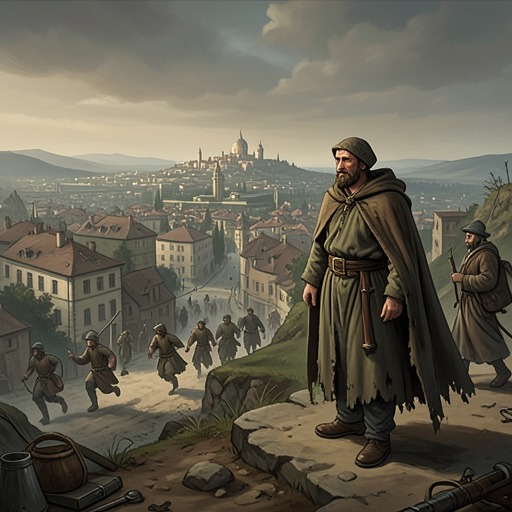
The hill’s highest point is a clearing containing a little thatched hut like a stable, its door shut. When Tirian and Jewel are brought there as prisoners, they find Shift seated outside it before a crowd of distressed Talking Beasts. His costume—a scarlet jacket made for a Dwarf, jewelled slippers that will not stay on his hind paws, and a paper crown—makes his assumed authority look makeshift even as the Calormenes address him as Aslan’s mouthpiece.
From this position Shift announces a program of forced labor as though it had been agreed with the Tisroc. Horses, bulls, and donkeys are to be sent to Calormen for work; moles, rabbits, and Dwarfs are assigned to its mines. He calls the arrangement paid employment, claiming that wages will go to Aslan’s treasury for everyone’s benefit, while the chief Calormene confirms the Tisroc’s approval. Shift’s promised improvements—roads, cities, schools, and offices—are paired with whips, muzzles, saddles, cages, kennels, and prisons. When an old Bear asks for freedom and for Aslan to speak directly, Shift defines freedom as doing what he commands.
The clearing also exposes how this rule suppresses challenge. When a speaker denounces Shift’s lies and begins to contrast Tash, who feeds on the blood of his people, with the good Lion whose blood saved Narnia, Calormenes strike him down before he can continue. Shift orders him taken away and tied to a tree, postponing justice in Aslan’s name. The claim to divine authority thus operates through labor assignments, silencing, and physical force, while the stable remains closed and Aslan’s voice is mediated by Shift.
Return and Resistance
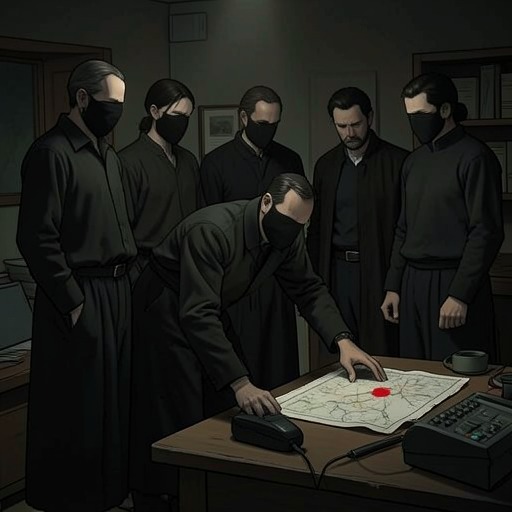
After learning that Shift’s plans reach beyond the hill, the resistance concludes that he has secretly dealt with the Tisroc and sent word to prepare a fleet for the seizure of Cair Paravel and all Narnia. Tirian and his companions decide to return to Stable Hill, proclaim the truth, and accept the adventure Aslan sends, despite expecting to face the Calormenes there and a larger invading force afterward.
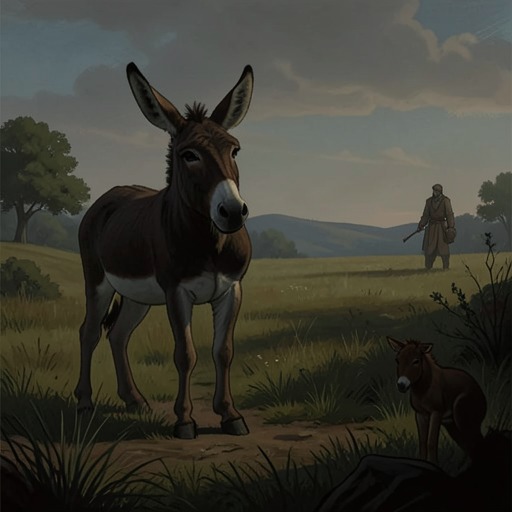
The approach is planned around the hill’s exposed clearing and the stable’s back. By daylight the site may be mostly deserted, since the frightened Beasts avoid approaching except when summoned to the night meetings, and Calormenes are poor woodsmen. The plan is to keep Puzzle out of sight behind the stable until the moment his appearance can surprise the assembled Narnians. The party proceeds northwest, moving from cover to cover through waits and false alarms; the journey from first sight of the hill to reaching the rear of the stable takes more than two hours. Near sunset they hide in holly trees about fifteen yards behind it, eat biscuit, and wait. At the sound of a gong and the sight of firelight on the other side, Tirian knows the hour has come.
The struggle at the hill becomes a direct contest over who will be driven through the stable door and for what purpose. Rishda orders his men to take the defenders alive if possible and hurl or drive them into the stable, where they are to be burned as an offering to Tash. The order turns the doorway into an intended instrument of capture and sacrifice. Yet after the final revelation the door has a different use: Aslan raises his head and calls that it is time, then repeats the call more loudly, and the Door flies open.
Threshold and Judgment
At the opened Door, the creatures who come face Aslan and divide according to their response. Those whose faces show fear and hatred turn to his left and disappear into the great black shadow streaming away from the doorway; Talking Beasts in that group cease to be talking animals. Those who love him, even when frightened, enter on his right. The scene makes the stable’s threshold a place of judgment, not the passage into the Calormene-controlled labor system Shift had announced.
The book does not leave the stable’s significance at the level of military defeat or escape. Aslan explains that the Narnia the children knew had a beginning and an end and was a shadow or copy of the real Narnia, which has always existed and always will. The old Narnia’s dear creatures have been drawn into the real one through the Door. The stable therefore marks the passage from a world that can be destroyed to a reality that is not bounded by that destruction.
As the old world reaches its end, Aslan tells the great giant to make an end; the giant throws his horn into the sea, reaches across the sky, and squeezes out the Sun. The cold air blows through the Doorway as its edges gather icicles. Later, Aslan reveals that the railway accident was real and that the children, along with their parents, are dead in the world they called the Shadow-Lands. Against that ending, the stable’s Door signifies not a return to the former Narnia but the beginning of the real story. Stable Hill’s movement from counterfeit sanctuary to threatened sacrificial enclosure and finally to open threshold gathers the book’s final contrast between deceptive authority, judgment, and lasting life.